Category Archives: Uncategorized

What are the Four Models?

As health care has continued to change and evolve, so has the relationship between health-care providers and their patients. The importance of patient choice or autonomy has continued to grow over time and these physician-patient relationships have shifted in response and formed groups that each have their own unique definition of autonomy. An excellent research paper conducted by Ezekiel J. Emanuel and Linda L. Emanuel called the “Four Models of the Physician-Patient Relationship” manages to categorize the physician-patient relationship into four groups and describes how each of them impact the provider-patient relationships of today. The four main categories in which these relationships have been sorted are the parental model, the informative model, the interpretive model and the deliberative model.

Each of these unique models has their own goals and roles for both the physician and patient, which is further explored in the individual model tabs above. Some physicians may prioritize their own opinions over the patients, like in the paternalistic model, while others may simply consider themselves a vessel of information to be delivered to the patient without bias, like in the informative model. Furthermore, some may believe that the patient needs and outside perspective to help them realize what values are most important to the patient, like in the interpretive model, while others may want to focus on only the health related values of treatment, as in the deliberative model. Clearly there is a wide range of how physicians can interact with their patients that can significantly vary with each professional.

My hope is that this website will be a tool to educate physicians on what model best describes their style, or allow others to discover what works best for them. With each model I have provided a description, along with other examples and information, that help clarify what the purpose of the model is. Not everyone may fall into these four categories, but they can definitely help identify what a physician prioritizes while working with patients. Feel free to check out the video below for more info!
What Model Suits My Style?

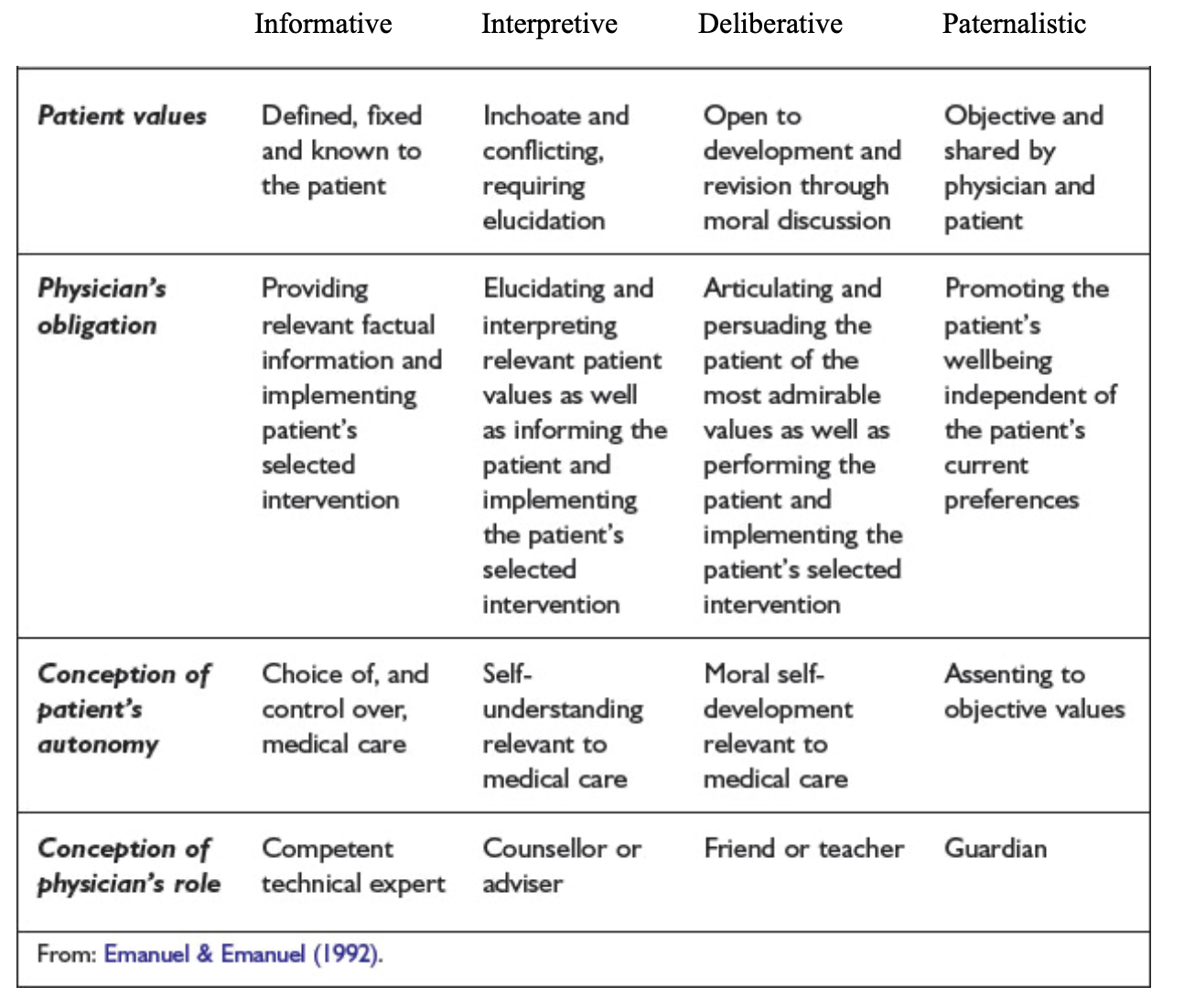
It can often be confusing to determine what model is the one that most accurately describes your physician-patient relationship, but there are a few key factors that can help enlighten you. Below is a table that helps further separate the groups into more distinct characteristics.

One major question that the physician should ask themselves is how do they value a patient’s autonomy? Is autonomy simply the ability to consent to a choice or is it more than that and developing a self-understanding/development? If you lean more towards a patient simply saying yes or no to a choice presented by a doctor, then the paternalistic model probably fits your definition, but if you believe that autonomy goes beyond that to self-improvement, then the interpretive or deliberative model is best for you.

Another aspect to consider is what the physician believes they’re obligation to the patient is. Does the physician believe that they only have the obligation to provide relevant information? If so, then the physician fits the informative model. Does the physician believe they have the obligation to prioritize the patient’s health above all else? If yes, then that physician follows the paternalistic model. Does the physician believe that they are obligated to deliberate with the patient and judge what health care values are most important? If you agree, then that fits the deliberative model. Does the physician believe its important that they understand the patients narrative story and interpret what intervention best fits? If so, then that is following the interpretive model.

Beyond autonomy and obligation there are many other factors that can fit these models. Sometimes, one model may be better suited than the others for a particular situation. For example, in an emergency scenario where a patient is unconscious or cannot make informed consent, a paternalistic approach may be necessary for the physician to make quick decisions for the patient’s survival. Even if you determine that one model fits you better than the others, it shouldn’t be too surprising that your methods may sometimes change depending on the situation.

Click on the link below to take a survey to find what method best suits you!

https://www.proprofs.com/quiz-school/ugc/story.php?title=the-four-models-of-physicianpatient-relationship